
. European Green Crab
(Carcinus maenas)
http://www.youtube.com/watch?v=d8BisuRv9cs
Scientific Classification:
Kingdom: Animalia
Phylum: Anthropoda
Subphylum: Crustacea
Class: Malacostraca
Order: Decapoda
Infraorder: Brachyura
Family: Portunidae
Genus: Carcinus
Species: C. maenas
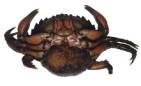
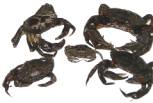
The European Green Crab, also know as the Shore Crab, is a marine invasive species that originally derived from the North and Baltic Seas, but now inhabits the coasts of South Africa, Australia. and on each coast of North America. Carcinus maenas are identified as small crustaceans, typically three inches across, usually associated with a dark green shell color, however, adults may have colors from dark green with yellow markings to orange or red. Bright yellow or red colors can be witnessed on the underside of the European Green Crab. This crustacean has been introduced to these new territories by "natural and human-driven causes" (Introduced Species Summary Project). Naturally, the Shore Crab is able to "sustain itself in disparate environmental conditions" (Introduced Species Summary Project). As larvae, the green crab can survive up to eighty days and have the ability to establish new populations along coasts. eventually spreading over vast areas. When ballast water ships are being transported across oceans, green crabs may cling to "mossy crevices of of heavy fouled outer hulls," or may lay hidden in the ships' cargo, transporting not only the ships across the oceans, but the crabs along with them, where they will establish new populations in new areas. This is believed how the invasion of the European Green Crab occurred on the east coast of the United States.
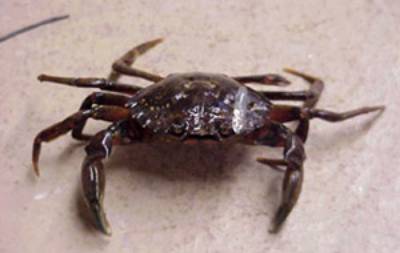
The European Green Crab is able to effectively establish itself in various environments because it is a lethal and effective forager, having the ability to tear apart bivalve shells. Compared to other crab species, the European Green Crab is faster and more deft in movement and foraging skills. It competes with native fish and sea birds for a wide selection of prey that consists of clams, oysters, mussel, marine worms, and small crustaceans. This species of crab is able to survive, and thrive, in various environments because it is highly adaptable to its surrounding environment and can withstand a "wide range of temperatures and salinities" (Introduced Species Summary Project). Also, the female Shore Crab has the ability to produce a mass quantity of eggs, generally around 200,000 eggs, in a single reproductive cycle. In addition, under certain conditions, this crab species is able to "survive up to two months out of water" (Introduced Species Summary Project).
As its ecological role, Carcinus maenas has "great potential to restructure the crab population" in the environments in which they have settled (Introduced Species Summary Project). This is because this crab species preys on the larvae of various other crab species, leading to a devastating impact on near shore nurseries. To avoid natural predators, such as the octopus, the European Green Crab remains close to shore. This crab is well protected from aerial predators as well because it inhabits protected areas, beneath rocks and in disturbed areas. Because shorebirds and the Shore Crab have very similar diets, the Shore Crab is a great threat to shorebirds. Therefore, Carcinus maenas both competes with and preys on native animals in their established ecosystems.
Because Carcinus maenas is an invasive species, it can pose a great threat to ecosystems. In Maine, this crab was responsible for devastating, practically wiping out, Maine's soft clam industry at the turn of the century. It is also partially responsible for the decline in the scallop population in Martha's Vineyard.
 Many industries fear the European Green Crab because it preys on their products. Along the East and West Coasts of the United States, the Shore Crab is a threat to shellfish industries because this crab has the ability to devastate oyster and clam populations. Also, this crab species has the ability to threaten bird species indirectly because it is an "intermediate host to marine worms" that can infect sea birds if that crab is consumed by them (Introduced Species Summary Project).
To reduce the impact of Carcinus maenas, many areas that are infested with the European Green Crab are attempting to "control the population to the point where it is not disastrous to the surround ecosystem" (Introduced Species Summary Project) because it is believed that the species cannot be eliminated. One method of controlling this crab population is by capturing them with the use of a pyramid shape mesh trap attached to a buoy that will trap the crab once it attempts to consume the baited fish. Another method of Shore Crab control is through the inspection of arriving boats since they tend to establish themselves in new areas because they were transported from other waters by means of boats. However, some scientists have been thinking of introducing the European Green Crab's "European nemesis, the Sacculina carcini barnacle- which pierces the crab's exoskeleton and causes sterility" to control the crab population (Introduced Species Summary Project). Many scientists believe that the population of Carcinus maenas will only increase because shipping traffic is common.
Works Cited:
Introduced Species Summary Project:
http://www.blogger.com/post-edit.g?blogID=593267891373580045&postID=8340483370027585245
As its ecological role, Carcinus maenas has "great potential to restructure the crab population" in the environments in which they have settled (Introduced Species Summary Project). This is because this crab species preys on the larvae of various other crab species, leading to a devastating impact on near shore nurseries. To avoid natural predators, such as the octopus, the European Green Crab remains close to shore. This crab is well protected from aerial predators as well because it inhabits protected areas, beneath rocks and in disturbed areas. Because shorebirds and the Shore Crab have very similar diets, the Shore Crab is a great threat to shorebirds. Therefore, Carcinus maenas both competes with and preys on native animals in their established ecosystems.
Because Carcinus maenas is an invasive species, it can pose a great threat to ecosystems. In Maine, this crab was responsible for devastating, practically wiping out, Maine's soft clam industry at the turn of the century. It is also partially responsible for the decline in the scallop population in Martha's Vineyard.
Many industries fear the European Green Crab because it preys on their products. Along the East and West Coasts of the United States, the Shore Crab is a threat to shellfish industries because this crab has the ability to devastate oyster and clam populations. Also, this crab species has the ability to threaten bird species indirectly because it is an "intermediate host to marine worms" that can infect sea birds if that crab is consumed by them (Introduced Species Summary Project).To reduce the impact of Carcinus maenas, many areas that are infested with the European Green Crab are attempting to "control the population to the point where it is not disastrous to the surround ecosystem" (Introduced Species Summary Project) because it is believed that the species cannot be eliminated. One method of controlling this crab population is by capturing them with the use of a pyramid shape mesh trap attached to a buoy that will trap the crab once it attempts to consume the baited fish. Another method of Shore Crab control is through the inspection of arriving boats since they tend to establish themselves in new areas because they were transported from other waters by means of boats. However, some scientists have been thinking of introducing the European Green Crab's "European nemesis, the Sacculina carcini barnacle- which pierces the crab's exoskeleton and causes sterility" to control the crab population (Introduced Species Summary Project). Many scientists believe that the population of Carcinus maenas will only increase because shipping traffic is common.
Works Cited:
Introduced Species Summary Project:
http://www.blogger.com/post-edit.g?blogID=593267891373580045&postID=8340483370027585245
