BP Oil Spill: Daily Dead Wildlife Tally

BP Oil Spill: Daily Dead Wildlife Tally
84 Days After Spill (http://dailydeadbirds.com/archive.html)

Monday, March 28, 2011

The European Green Crab: An Invasive Species

. European Green Crab
(Carcinus maenas)

http://www.youtube.com/watch?v=d8BisuRv9cs

Scientific Classification:
Kingdom: Animalia
Phylum: Anthropoda
Subphylum: Crustacea
Class: Malacostraca
Order: Decapoda
Infraorder: Brachyura
Family: Portunidae
Genus: Carcinus
Species: C. maenas

The European Green Crab, also know as the Shore Crab, is a marine invasive species that originally derived from the North and Baltic Seas, but now inhabits the coasts of South Africa, Australia. and on each coast of North America. Carcinus maenas are identified as small crustaceans, typically three inches across, usually associated with a dark green shell color, however, adults may have colors from dark green with yellow markings to orange or red. Bright yellow or red colors can be witnessed on the underside of the European Green Crab. This crustacean has been introduced to these new territories by "natural and human-driven causes" (Introduced Species Summary Project). Naturally, the Shore Crab is able to "sustain itself in disparate environmental conditions" (Introduced Species Summary Project). As larvae, the green crab can survive up to eighty days and have the ability to establish new populations along coasts. eventually spreading over vast areas. When ballast water ships are being transported across oceans, green crabs may cling to "mossy crevices of of heavy fouled outer hulls," or may lay hidden in the ships' cargo, transporting not only the ships across the oceans, but the crabs along with them, where they will establish new populations in new areas. This is believed how the invasion of the European Green Crab occurred on the east coast of the United States.
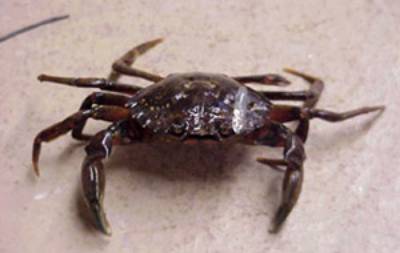
The European Green Crab is able to effectively establish itself in various environments because it is a lethal and effective forager, having the ability to tear apart bivalve shells. Compared to other crab species, the European Green Crab is faster and more deft in movement and foraging skills. It competes with native fish and sea birds for a wide selection of prey that consists of clams, oysters, mussel, marine worms, and small crustaceans. This species of crab is able to survive, and thrive, in various environments because it is highly adaptable to its surrounding environment and can withstand a "wide range of temperatures and salinities" (Introduced Species Summary Project). Also, the female Shore Crab has the ability to produce a mass quantity of eggs, generally around 200,000 eggs, in a single reproductive cycle. In addition, under certain conditions, this crab species is able to "survive up to two months out of water" (Introduced Species Summary Project).

As its ecological role, Carcinus maenas has "great potential to restructure the crab population" in the environments in which they have settled (Introduced Species Summary Project). This is because this crab species preys on the larvae of various other crab species, leading to a devastating impact on near shore nurseries. To avoid natural predators, such as the octopus, the European Green Crab remains close to shore. This crab is well protected from aerial predators as well because it inhabits protected areas, beneath rocks and in disturbed areas. Because shorebirds and the Shore Crab have very similar diets, the Shore Crab is a great threat to shorebirds. Therefore, Carcinus maenas both competes with and preys on native animals in their established ecosystems.


Because Carcinus maenas is an invasive species, it can pose a great threat to ecosystems. In Maine, this crab was responsible for devastating, practically wiping out, Maine's soft clam industry at the turn of the century. It is also partially responsible for the decline in the scallop population in Martha's Vineyard.
Many industries fear the European Green Crab because it preys on their products. Along the East and West Coasts of the United States, the Shore Crab is a threat to shellfish industries because this crab has the ability to devastate oyster and clam populations. Also, this crab species has the ability to threaten bird species indirectly because it is an "intermediate host to marine worms" that can infect sea birds if that crab is consumed by them (Introduced Species Summary Project).

To reduce the impact of Carcinus maenas, many areas that are infested with the European Green Crab are attempting to "control the population to the point where it is not disastrous to the surround ecosystem" (Introduced Species Summary Project) because it is believed that the species cannot be eliminated. One method of controlling this crab population is by capturing them with the use of a pyramid shape mesh trap attached to a buoy that will trap the crab once it attempts to consume the baited fish. Another method of Shore Crab control is through the inspection of arriving boats since they tend to establish themselves in new areas because they were transported from other waters by means of boats.  However, some scientists have been thinking of introducing the European Green Crab's "European nemesis, the Sacculina carcini barnacle- which pierces the crab's exoskeleton and causes sterility" to control the crab population (Introduced Species Summary Project). Many scientists believe that the population of Carcinus maenas will only increase because shipping traffic is common.


Works Cited:
Introduced Species Summary Project:
http://www.blogger.com/post-edit.g?blogID=593267891373580045&postID=8340483370027585245

Tuesday, March 1, 2011

Economic Consequences of Marine Oil Spills

http://www.youtube.com/watch?v=NQqPnIYl7QI

Economic disasters and disturbances usually accompany marine oil spills. When an oil spill occurs, businesses that rely on tourists may temporarily suffer. Hotels and restaurants, in particular, suffer from a nearby oil spill due to the tainted local waters and the possibility of poisoned seafood due to the oil. "Recreational activities such as bathing, boating, angling and diving" also experience the impact that results from nearby oil spills since they all rely on clean water (Economic Impacts). Not only tourist-centered businesses endure the effects of an oil spill, "industries that rely on seawater for their normal operation can also be adversely affected", such as power stations and desalination plants (Economic Impacts). These businesses are at risk of being harmed because there is a large possibility that if there is a nearby oil spill, then "their water intakes are located close to the sea surface, thereby increasing the possibility of drawing in floating oil" (Economic Impacts). Other coastal industries suffer from oil spills because their normal operations are often disrupted, industries "such as shipyard, ports and harbours" (Economic Impacts). 


Perhaps the industry that is most negatively impacted by a marine oil spill is the fishing industry: "An oil spill can directly damage the boats and gear used for catching or cultivating marine species", along with the damaging of the cultivating species themselves (Economic Impacts). Floating fishing equipment and "fixed traps extending above the sea surface" are in danger of being contaminated because they may come into contact with the spilled oil (Economic Impact). Equipment that rests on the bottom of the ocean is usually safe from the surfaced oil; however, it may become infected by the spilled oil when the equipment is hauled from the water. There is also the possibility of sunken oil contaminating the equipment. The fish markets are impacted due to the possibility of infected/poisoned fish. Under the circumstances of a polluted area due to an oil spill, industries that rely on the seawater and its inhabitants suffer greatly and the markets for seafood plunge rapidly. (Economic Impacts) 

Source: 
Economic Impacts: http://www.itopf.com/marine-spills/effects/economic-impacts/

Wednesday, February 9, 2011

Oil Spill Clean-Up Methods

http://www.youtube.com/watch?v=EwQOD_Ir2vQ

Due to the variations in marine oil spills, depending on the type of oil spilt, the location of the spilt oil, and the natural weather and environmental conditions involved in the area of the spilt oil, there are different methods involved in the clean-up of marine oil spills. The "green" method of using hair to collect oil, as seen in the video, is a relatively new idea, but effective because hair naturally collects oil. However, more common methods of marine oil removal from the ocean's surfaces are through natural degradation, dispersant degradation, biological degradation, or the collection of oil with the aid of boomers.

Through natural degradation, marine oil slicks are dependent upon the break down of oil through natural means, which involves being untouched by man. This method is used when there is no possibility of the oil affecting coastal regions, due to pollution, and marine industries. If left alone, the oil will disperse on its own when wind, sun, current, and wave motion react with the oil, allowing it to evaporate as well.

In order to surround and isolate a marine oil slick to prevent the further spread of the oil slick, boomers are used. Because oil floats on the surface of water, these boomers, similar to blockades, rest on top of the water to prevent the spread of the oil. Once trapped, skimmer equipment is used within the isolated oil location in order to collect the oil into storage tanks on the ocean surface.

Through dispersant and biological degradation of oil slicks, substances are added to the oil in order for it to become harmless and be able to dissipate. In dispersant degradation, chemicals are added to the oil slick to break down the oil for it to be able to naturally degrade more rapidly. They act by reducing the surface tension that prevents the mixture of oil and water. In biological degradation, "biological agents" are added to the spill so that biodegradation will occur at a more rapid rate as well. These "agents" are usually bacteria and other microorganisms that work to break down the oil into harmless substances such as fatty acids and carbon dioxide. With the addition of fertilizing nutrients, such as nitrogen and phosphorus, the rate of biodegradation is increased because these nutrients stimulate the growth of microorganisms that help break down oil.

These methods, depending on the conditions of the oil spills, can be very effective, and help keep the oceans clean.

Source:
http://www.ceoe.udel.edu/oilspill/cleanup.html

Wednesday, January 5, 2011

Internal Effects of Oil Spills on Marine Organisms

The impact that exposed oil has on a marine environment is tremendous due to the external and internal damage that both directly and indirectly affects the marine organisms that inhabit these afflicted aquatic ecosystems when contact is made between the oil and the marine organisms. Because oil slicks coat the surface of the waters, marine organisms that remain close to the surface waters, whether for feeding or breathing (mammals), have the greatest potential of coming in contact with the toxic oil, and thus the greatest potential of coming to harm. Thus, the marine organisms that are at greatest risk include sea birds, marine mammals, cetaceans, sirenians, pinnipeds, sea turtles, and fish. Unfortunately, all these organisms are at risk to suffer from "poisoning" due to the consumption of the crude oil. (Effects of Maritime Oil Spills on Wildlife) Other direct internal effects on the wildlife include "the destruction of red blood cells" which damages the immune response, "pneumonia", "intestinal damage", "reduced reproduction ability", "hypothermia", "congested lungs" and "damaged airways", "inflammation and infection" caused by irritation of mucous membranes due to oil exposure, and "secondary organ dysfunction" caused by accidental consumption of oil. (Effects of Maritime Oil Spills on Wildlife) The indirect effects that oil exposure may have on these organisms can be just as harmful: "decreased body mass" caused by the disruption of their diet, making the animals a greater risk of being prey and unhealthy, "behavioral changes" due to the exposure of oil to an organism's habitat can cause great stress, "food searching instincts such as diving and swimming are inhibited", leading to to malnutrition due to the incapability of finding food, and indirect poisoning by consuming contaminated prey. (Effects of Maritime Oil Spills on Wildlife) Many oil-contaminated organisms die, and much less survive, due to these extremely hazardous oil spills.

Source:
http://www.amsa.gov.au/marine_environment_protection/national_plan/general_information/oiled_wildlife/Oil_Spill_Effects_on_Wildlife_and_Non-Avian_Marine_Life.asp

Monday, December 6, 2010

External Effects of Oil Spills on Marine Organisms

Once oil has been exposed to marine environments, the oil spreads rapidly, coating the surface waters with the aid of wind and currents: "A single gallon of oil can create an oil slick up to a couple of acres in size!" (Effects of oil spills). Over time, when the oil and the water begin to mix, the oil begins to weather, creating a "mousse", which is a sticky, oily substance that attaches to "whatever it comes in contact with" (Effects of oil spills). This "mousse" is extremely harmful to marine organisms, having both internal and external effects. Many marine organisms are incapable of escaping such oil slicks, not knowing how to avoid them, and many fish are, actually, attracted to them because they "can resemble food" (Effects of oil spills). (Effects of oil spills) 


Following a marine oil spill, the oil in the marine habitats coats the bodies of marine organisms with a thick layer of oil. This oil only becomes stickier over time. Because oil and water do not mix immediately once an oil spill occurs and coats the surface of the water, marine mammals and birds are targets of the harmful effects of oil spills. Seals, dolphins, and other marine mammals "have been seen swimming and feeding in or near an oil spill" (Effects of Oil on Wildlife). The fish that are attracted and lured to the oil spills that resemble food are prey to the sea birds who dive through the oil slicks in an attempt capture their prey. (Effects of Oil on Wildlife) 


Once the sticky, weathered oil, usually crude or bunker oil fuels, has attached itself to the fur and feathers of the marine organisms, many harmful effects to the marine organisms are the results. Many sea birds are susceptible to hypothermia because the oil can reduce or destroy "the insulation and waterproofing properties of their feathers" (Effects of Oil on Wildlife). Similarly, hypothermia is also a threat to fur seal pups because the oil can also reduce or destroy the insulation of their woolly fur. In addition, sea birds are prone to sinking and drowning when they come in contact with oil because "oiled feathers weigh more, and their sticky feathers cannot trap enough air between them to keep them buoyant" (Effects of Oil on Wildlife). Also, it is a possibility that seal pups will drown because the oil cam stick their flippers to their bodies. Many marine mammals lose much body weight because "they can not feed due to contamination of their environment by oil" (Effects of Oil on Wildlife). These are just some of the harmful, and, sometimes, fatal, effects of oil spills on marine organisms. (Effects of Oil on Wildlife) 


Sources: 
Effects of oil spills: <http://www.greenlivingtips.com/blogs/164/Effects-of-oil-spills.html> 
Effects of Oil on Wildlife: <http://www.amsa.gov.au/marine_environment_protection/educational_resources_and_information/teachers/the_effects_of_oil_on_wildlife.asp>  

Thursday, October 14, 2010

Introduction to Marine Oil Spills

706 million gallons: the amount of waste oil that enters the marine environment per year. Oil can enter the oceans through many different passages, but the majority of oil that enters the ocean originates from "land based sources and from unregulated recreational boating" (Oil Spills: Impact on the Ocean). Other forms of oil entering the marine environment include drainage of storm water that contains components of oil and improper treatment of waste disposal. Tanker crashes and other transportation accidents accommodate for 5.2% of oil that exists in the oceans, routine repairs and maintenance of ships make up 20%, and 13% of the oil within the oceans come from "hydrogen particles from online air pollution", and 8% is due to the natural uplifting of oil from the ocean floor (Oil Spills: Impact on the Ocean).

The gravity of marine oil spills relies on many factors. Factors that influence the severity of marine oil spills include "the type and quantity of oil spilled, the season and weather, the type of shoreline, and the type of waves and tidal energy in the area of the spill" (Effects of Oil Spills on Wildlife and Habitat). Because the density of oil is less than 1g/mL (the density of water), oil floats on the surface of the ocean and coats the water as a sheen. The intensity of waves, currents, and winds can expand the coverage of oil to larger areas in the marine environment. 

The way oil affects the environment physically, chemically, and biologically is called weathering, and weathering can actually reduce the harmful toxins in oil over time. Other forms that diminish oil from the marine environment include evaporation, decomposition by sunlight (photolysis), and decomposition by microorganisms (biodegradation). Biodegradation relies on the availability of nutrients and oxygen, the type of microorganism, and the temperature.  In addition, small amounts of waste oil dissolve in the ocean waters. 

Sources: 
http://alaska.fws.gov/media/unalaska/Oil%20Spill%20Fact%20Sheet.pdf
http://www.waterencyclopedia.com/Oc-Po/Oil-Spills-Impact-on-the-Ocean.html